
Dear Colleagues,
I hope that everyone enjoyed their summer and managed to take some well-deserved time for themselves. As the new academic year gets underway and people are back on campus, I wanted to provide Federation members with a few updates and some reminders of upcoming Union events.
Congratulations to everyone who received a promotion in the last academic year. In addition to the new title, there is a base salary increase that comes with a promotion; $3000 for teaching faculty, $7000 for Associate Professor and $9000 for full Professor. This should appear in the next pay period.
Federation Meetings & Events
The Federation executive board has made the decision that the Faculty Federation general membership meetings will return to being in-person meetings (with coffee and cookies) with a remote option for those whose circumstances preclude them from being on campus. This will not be a hybrid arrangement but will provide the ability to listen to the meeting. Please contact Stacey for the link at salzaibak@umassd.edu. Hopefully, being in-person will increase engagement during the membership meetings.
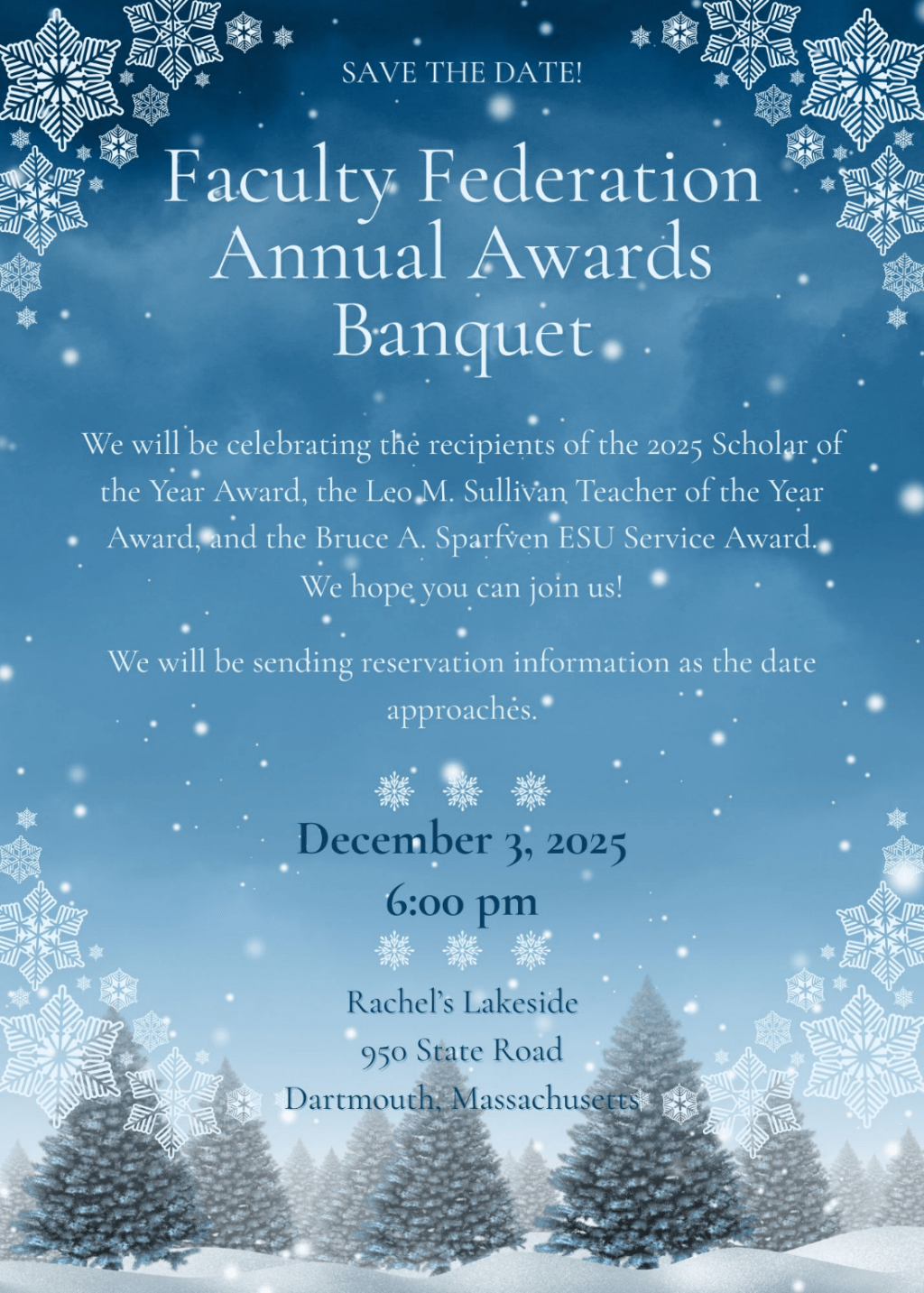
Continuing with the membership outreach that began last year, the Federation will be hosting open house events in the Federation Office (Violette Research, Rm. 222). This is an opportunity to ask question, make comments or simply just chat about what’s happening on campus– and there is a lot happening. Glaucia Silva, Gina Reis and I will be available, as will other members of the executive board. Please join us for Coffee with Federation-ESU Leaders on Wednesday, September 18, 9:30 am to 10:30 am and Friday, October 25, 9:30 am to 10:30 am. The Federation will also be hosting its annual Fall Reception Federation with adult beverages and hors d’oeuvres in the Grand Reading Room on Monday, October 28, 2:00 pm to 4:00 pm. Calendar invitations for these events, and the general membership meetings, will be sent shortly. All members of the Union are invited to attend, but I would like to extend a particular invitation to the new faculty who started at UMass Dartmouth this year.
Free Speech & Assembly on Campus
The right to assemble and have your voice heard is a constitutionally protected right. The Federation has reviewed the proposed changes to the campus policy on “Public Forum Use of University Facilities and Land”, and has obtained the following advice from AFT Mass. legal counsel.
Regarding the campus free speech zone that the campus policy specifies, AFT counsel’s advice is;
Courts have established the right of public universities to set limits on the “time, place and manner” of protests. This means that while universities must protect free speech, they can set reasonable limits on when and where that speech occurs. These limits must be reasonable, serve a legitimate purpose and still leave adequate opportunities for that speech to be heard. That would allow universities to set reasonable hours for noise and safety reasons, and to ban camping on campus grounds. We have the right to protest, but there’s no guarantee of shelter.
The use of the Public forums uses are limited to appropriate public forum spaces, which specifically do not include, among other locations, faculty and administrative offices, classrooms and other instructional facilities, athletic facilities, and residential facilities.
Based on this, the “campus free speech zone” defined in this policy should be unenforceable.
Regarding the 48-hour notice requirement before holding an event on campus, counsel’s advice is that it is likely the University cannot require advance notice for all events but would have to consider factors such as those listed in the following advice from the ACLU.
Do I need a permit before I engage in free speech activity?
Not usually. However, certain types of events require permits. Generally, these events are:
· A march or parade that does not stay on the sidewalk, and other events that require blocking traffic or street closure
· A large rally requiring the use of sound amplifying devices; or
· A rally at certain designated parks or plazas
Many permit procedures require that the application be filed several weeks in advance of the event. However, the First Amendment prohibits such an advance notice requirement from being used to prevent rallies or demonstrations that are rapid responses to unforeseeable and recent events. Also, many permit ordinances give a lot of discretion to the police or city officials to impose conditions on the event, such as the route of a march or the sound levels of amplification equipment. Such restrictions may violate the First Amendment if they are unnecessary for traffic control or public safety, or if they interfere significantly with effective communication with the intended audience. A permit cannot be denied because the event is controversial or will express unpopular views.
Specific problems
If organizers have not obtained a permit, where can a march take place?
If marchers stay on the sidewalks and obey traffic and pedestrian signals, their activity is constitutionally protected even without a permit. Marchers may be required to allow enough space on the sidewalk for normal pedestrian traffic and may not maliciously obstruct or detain passers-by.
May I distribute leaflets and other literature on public sidewalks?
Yes. You may approach pedestrians on public sidewalks with leaflets, newspapers, petitions and solicitations for donations without a permit. Tables may also be set up on sidewalks for these purposes if sufficient room is left for pedestrians to pass. These types of free speech activities are legal as long as entrances to buildings are not blocked and passers-by are not physically and maliciously detained. However, a permit may be required to set up a table.
Do I have a right to picket on public sidewalks?
Yes, and this is also an activity for which a permit is not required. However, picketing must be done in an orderly, non-disruptive fashion so that pedestrians can pass by and entrances to buildings are not blocked.
Can government impose a financial charge on exercising free speech rights?
Some local governments have required a fee as a condition of exercising free speech rights, such as application fees, security deposits for clean-up, or charges to cover overtime police costs. Charges that cover actual administrative costs have been permitted by some courts. However, if the costs are greater because an event is controversial (or a hostile crowd is expected)—such as requiring a large insurance policy—then the courts will not permit it. Also, regulations with financial requirements should include a waiver for groups that cannot afford the charge, so that even grassroots organizations can exercise their free speech rights. Therefore, a group without significant financial resources should not be prevented from engaging in a march simply because it cannot afford the charges the City would like to impose.
Dean Searches
With the announcement of transitions in college leadership for Arts & Sciences, Engineering and Visual & Performing Arts, the Federation is preparing to conduct the contractually required elections to appoint full-time faculty to each search committee. Chancellor Fuller has authorized the formation of these committees so please look for the call for nominations from Stacey.
Contract Negotiations
The Faculty Federation will be back at the negotiating table later this semester. As you may remember, there was a one-year contract extension in 2023 (which expired on June 30, 2024) that included the two 4% salary increases as well as a $500/FTE “salary adjustment” pool, the last part of this salary adjustment pool was distributed at the end of May. The Federation has an agreement with the Administration that the terms of the 2020-2023 CBA will remain in effect until a successor agreement is ratified by the Federation membership. As the negotiating team prepares for bargaining, the Faculty Federation is asking that members submit proposals for changes that they would like to see in the contract.
Proposals should be submitted in contractual-like language and should clearly describe what it is that you are asking to be changed. The best and simplest method is to copy the relevant sections from the current (2023) Faculty Federation Agreement (the PDF file available here 2020-2023 Faculty Federation Contract) into a Word file and note the modification. Using track changes isn’t necessary and can actually be confusing.
If the changes are a few words in a paragraph, then strike-through what you want to delete and add (in a different colour) inline the new language you are proposing. For more extensive changes, strike-though the entire paragraph(s) and add (in colour) the replacement text immediately below. This way it will be clear to the negotiating team exactly what changes are being proposed when they review the submitted proposals. Also, note in your submission the article number and the page number it appears on in the current (2020-2023) Faculty Federation Agreement.
Please also include a brief paragraph outlining the proposed changes and the rationale for them.
The process for determining the final packet of proposals that the Faculty Federation will bring to the bargaining table is as follows:
- proposals requesting changes may be submitted by any member of the Union.
- the Federation’s negotiating team will review all submissions in order to create a final packet of proposals. This may include merging language and ideas from multiple proposals addressing the same topic.
- the packet of proposals will be presented to the Federation membership at a special Federation meeting before bringing them to the bargaining table.
In Solidarity.


 UMASSD Faculty Federation AFT Local 1895
Leave a comment